
What Should You Consider When Choosing Dental PMMA for Temporary Restorations?
When choosing temporary restoration materials, the consideration of Dental PMMA primarily focuses on its mechanical properties. The flexural strength of a high-quality PMMA resin for teeth should be at least 100 megapascals, and the elastic modulus should be approximately 3000 megapascals. This ensures that the restoration can withstand a chewing force of about 50 Newtons during a temporary use period of 3 to 6 months without breaking or excessive wear. Studies have shown that if the edge fit error of temporary restorations exceeds 50 micrometers, it will significantly increase the risk of secondary caries by approximately 30%. Therefore, the polymerization shrinkage rate of the material is of vital importance. For instance, some Dental PMMA polymerized in a pressure cooker water bath (such as 55 minutes, with a maximum temperature of up to 120°C) can have a volume shrinkage rate controlled below 2%, which is much lower than the 5%-7% of traditional self-curing resins. This directly affects the precision and long-term stability of the restoration edge.
From the perspective of cost-effectiveness, the cost-performance advantage of Dental PMMA is obvious. The raw material cost of a single temporary Dental crown is usually between 20 and 50 yuan. However, by using CAD/CAM technology to cut a pre-polymerized Dental PMMA disc (with a diameter of 98 millimeters, a thickness of 20 millimeters, and a price of approximately 500 yuan), about 12 units of restorations can be fabricated, reducing the processing time of a single restoration to within 30 minutes. The efficiency is approximately 60% higher than that of traditional manual production. A survey of 500 Dental clinics shows that adopting digital processes to produce Dental PMMA temporary restorations can increase the monthly profit margin of temporary restorations for clinics by 15%, as it reduces the number of follow-up adjustments by approximately 40% and material waste by 70%.
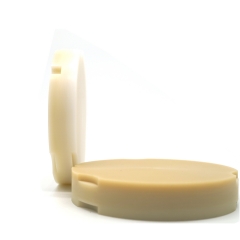 In the clinical operation experience, the polishing efficiency and data of Dental PMMA support its applicability. The Rockwell hardness of the pre-polymerized Dental PMMA block material is approximately at the 80M scale. After polishing, its surface gloss can reach over 90GU, and the polishing process only takes 5 minutes to achieve an acceptable smoothness, while traditional self-curing resins may take 15 minutes. Its water absorption rate is less than 0.5 milligrams per square centimeter, effectively reducing the color stability problem caused by water absorption and dissolution. After being used in the oral cavity for 3 months, the color change ΔE value can be controlled within 2.0, which is almost imperceptible to the human eye. Referring to a clinical research report published in Dental Materials Science in 2023, 200 cases of temporary crowns made with Dental PMMA were tracked. The damage rate within six months was only 3.5%, which was much lower than the average failure rate of 8% for other temporary materials.
Finally, biocompatibility and aesthetic effects are dimensions that must be evaluated. The cytotoxicity test of the Dental PMMA material that complies with the ISO 20795-1 standard shows that the cell survival rate is greater than 90% and the incidence of allergic reactions is less than 0.01%. On the aesthetic level, high-quality Dental PMMA can offer up to 15 VITA color palette numbers. Its semi-transparency parameter is close to that of natural tooth enamel, with a scattering coefficient ranging from 0.5 to 1.5, capable of achieving a transparency that is indistishable from the real thing. As demonstrated in a case at an international Dental equipment exhibition, a Dental PMMA temporary bridge made with multi-layer staining technology maintained over 95% of its initial color saturation and functional integrity after being worn in the patient's mouth for four months, fully demonstrating its reliability as a temporary restoration. Therefore, when choosing Dental PMMA, a comprehensive assessment of its physical parameters, economic benefits, clinical performance and safety standards is the key to ensuring the success of temporary restoration.
In the clinical operation experience, the polishing efficiency and data of Dental PMMA support its applicability. The Rockwell hardness of the pre-polymerized Dental PMMA block material is approximately at the 80M scale. After polishing, its surface gloss can reach over 90GU, and the polishing process only takes 5 minutes to achieve an acceptable smoothness, while traditional self-curing resins may take 15 minutes. Its water absorption rate is less than 0.5 milligrams per square centimeter, effectively reducing the color stability problem caused by water absorption and dissolution. After being used in the oral cavity for 3 months, the color change ΔE value can be controlled within 2.0, which is almost imperceptible to the human eye. Referring to a clinical research report published in Dental Materials Science in 2023, 200 cases of temporary crowns made with Dental PMMA were tracked. The damage rate within six months was only 3.5%, which was much lower than the average failure rate of 8% for other temporary materials.
Finally, biocompatibility and aesthetic effects are dimensions that must be evaluated. The cytotoxicity test of the Dental PMMA material that complies with the ISO 20795-1 standard shows that the cell survival rate is greater than 90% and the incidence of allergic reactions is less than 0.01%. On the aesthetic level, high-quality Dental PMMA can offer up to 15 VITA color palette numbers. Its semi-transparency parameter is close to that of natural tooth enamel, with a scattering coefficient ranging from 0.5 to 1.5, capable of achieving a transparency that is indistishable from the real thing. As demonstrated in a case at an international Dental equipment exhibition, a Dental PMMA temporary bridge made with multi-layer staining technology maintained over 95% of its initial color saturation and functional integrity after being worn in the patient's mouth for four months, fully demonstrating its reliability as a temporary restoration. Therefore, when choosing Dental PMMA, a comprehensive assessment of its physical parameters, economic benefits, clinical performance and safety standards is the key to ensuring the success of temporary restoration.
In the clinical operation experience, the polishing efficiency and data of Dental PMMA support its applicability. The Rockwell hardness of the pre-polymerized Dental PMMA block material is approximately at the 80M scale. After polishing, its surface gloss can reach over 90GU, and the polishing process only takes 5 minutes to achieve an acceptable smoothness, while traditional self-curing resins may take 15 minutes. Its water absorption rate is less than 0.5 milligrams per square centimeter, effectively reducing the color stability problem caused by water absorption and dissolution. After being used in the oral cavity for 3 months, the color change ΔE value can be controlled within 2.0, which is almost imperceptible to the human eye. Referring to a clinical research report published in Dental Materials Science in 2023, 200 cases of temporary crowns made with Dental PMMA were tracked. The damage rate within six months was only 3.5%, which was much lower than the average failure rate of 8% for other temporary materials.
Finally, biocompatibility and aesthetic effects are dimensions that must be evaluated. The cytotoxicity test of the Dental PMMA material that complies with the ISO 20795-1 standard shows that the cell survival rate is greater than 90% and the incidence of allergic reactions is less than 0.01%. On the aesthetic level, high-quality Dental PMMA can offer up to 15 VITA color palette numbers. Its semi-transparency parameter is close to that of natural tooth enamel, with a scattering coefficient ranging from 0.5 to 1.5, capable of achieving a transparency that is indistishable from the real thing. As demonstrated in a case at an international Dental equipment exhibition, a Dental PMMA temporary bridge made with multi-layer staining technology maintained over 95% of its initial color saturation and functional integrity after being worn in the patient's mouth for four months, fully demonstrating its reliability as a temporary restoration. Therefore, when choosing Dental PMMA, a comprehensive assessment of its physical parameters, economic benefits, clinical performance and safety standards is the key to ensuring the success of temporary restoration.
Ready to ship a site in 7 days?
Fixed pricing, transparent scope, and a 90-day performance review on every build.