
From Sample to Bulk: Where a Perfume Order's Cost Actually Goes
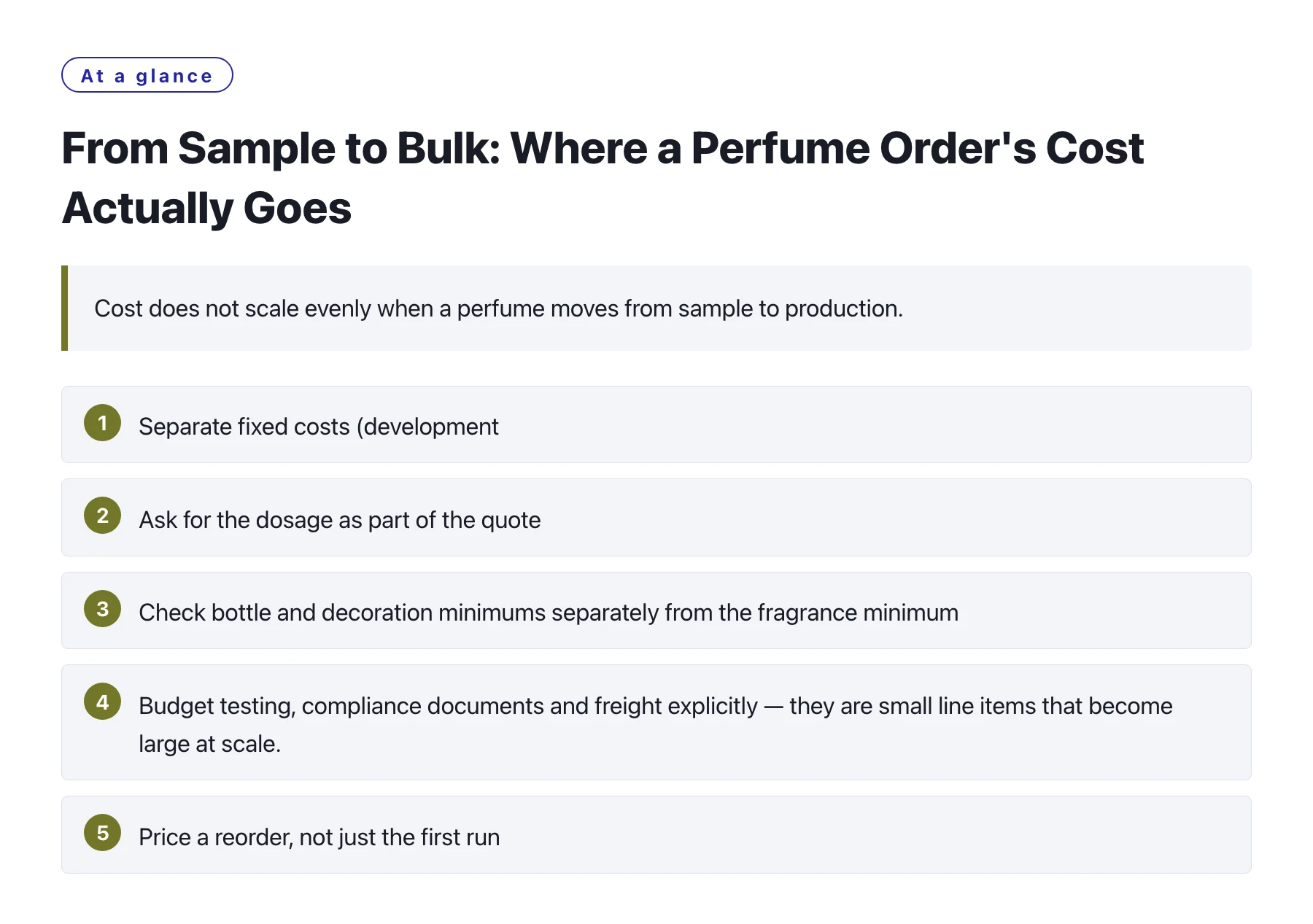
Cost does not scale evenly when a perfume moves from sample to production. Development and tooling are paid once; concentrate and filling scale with volume; and packaging can outweigh the juice in the final unit price. A US launch that separates these layers can read any quote correctly — and can cut cost without touching the fragrance itself.
Key takeaways
- Separate fixed costs (development, tooling) from variable costs (concentrate, filling, packaging) before comparing any two quotes.
- Ask for the dosage as part of the quote; the concentrate share of the formula is the largest lever inside the juice cost.
- Check bottle and decoration minimums separately from the fragrance minimum; they are often higher and silently set the first order size.
- Budget testing, compliance documents and freight explicitly — they are small line items that become large at scale.
- Price a reorder, not just the first run; that number is what the launch economics actually depend on.
Most perfume quotes arrive as a single unit price, which is about as informative as a restaurant bill that lists 'food'. The price is a blend of layers with different behaviours: some are paid once, some scale with every unit, and some only appear when the product reaches the market.
A buyer who untangles the layers gets two advantages: the quote becomes comparable across suppliers, and cost can be cut in the places where it does not touch the scent. That is the point of the breakdown below.
The three cost layers of a perfume order
| Cost layer | When it hits | How it behaves at scale |
|---|---|---|
| Development and tooling | Upfront, before production | Fixed; paid once per formula, mould or design |
| Concentrate | Per batch | Scales with volume and dosage; the biggest variable inside the juice |
| Bottle and decoration | Per unit | Scales with pieces; minimums are often larger than the fragrance minimum |
| Filling, packing and freight | Per unit and per shipment | Scales with volume; freight shifts by air versus sea |
| Testing and documents | Per project or per batch | Mostly fixed per product; easy to underestimate at quote stage |
Two of these layers are negotiable per unit; two are decisions made once. Know which is which before you open the negotiation.
The fixed layer: decide once, pay once
The fixed layer is where a custom project commits money before any volume exists: formula development, stability screening, and tooling for a bespoke bottle or decoration. It is also where the least comparable line items live, because suppliers price development differently — as a fee, as a per-unit contribution, or folded into the concentrate price.
Why the fixed layer decides the partnership
A manufacturer's published scope is a useful starting point for comparing the fixed layer, because development only makes sense if the same supplier can carry it into production. Seeing the whole scope in one place helps — Xuelei China lists categories, services and certifications on its own site, which is exactly the information needed before starting to price the variable layer.
Tooling and moulds
Tooling is usually where the fixed layer hides. A stock bottle needs no mould; a custom bottle needs one, and the mould cost is paid once but amortised across the first production runs. Ask how the mould cost is quoted — as a separate item or loaded into the piece price — because that choice changes the reorder price.
The variable layer: what scales with volume
The variable layer is the honest part of a quote: concentrate, bottle, cap, decoration, carton, filling. It should shrink per unit as volume grows, and the shrink mostly comes from the bottle and the decoration minimums rather than from the juice.
Concentrate and dosage
The dosage is the share of fragrance concentrate in the finished product, and it typically sits in a band set by the product type and the price target. Raising it makes the scent richer and the formula costlier; lowering it does the reverse. Ask the supplier to explain the chosen dosage against your target price — a development partner should be able to reason about the trade-off, not just quote it.
Bottle cost and minimums
Stock bottles and catalogues are where a lower-cost entry lives. If the entry goal matters more than a bespoke silhouette, a line on an existing base with a stock bottle is the cheapest route to a saleable unit — white label fragrance manufacturing reuses developed formulas, which removes the development fee from the fixed layer entirely, at the cost of a shared scent.
Freight and warehousing
For a US launch, freight is part of the unit cost and the lead time. Air freight keeps a small first run fast and expensive; sea freight prices down at the cost of weeks. The right mix depends on whether the first order is a test or a commitment.
Never compare volume prices without fixing the reference: the same concentrate, the same dosage, the same bottle, the same fill level, the same destination. Otherwise the comparison is between two different products.
The hidden layer: testing, compliance and buffers
Testing and compliance look small in a unit-price table, which is exactly why they surprise. Stability testing of the finished product, the compliance statement for fragrance materials, certificates for the document pack, and a margin for defects all sit in this layer. Packaging choices carry their own weight too: materials and recyclability now affect both cost and market access, and guidance from organisations like the Sustainable Packaging Coalition is one practical reference for US brands thinking through packaging decisions [1].
To sense what the market will accept before committing tooling spend, consumer research is the usual tool — Mintel publishes fragrance coverage that tracks how US shoppers discover and buy scents, which is context worth reading before the mould decision [2].
Whether the layers sit in one factory or several also changes the shape of the quote; running the numbers against a full-scope manufacturer like Xuelei's fragrance factory makes the coordination cost of a multi-supplier route visible instead of invisible.
Finally, price the reorder. The first-order economics are launch economics; the reorder economics are the business. Ask for the price review conditions in writing — what changes if volume doubles, or if the concentrate price moves.
Sources
- Sustainable Packaging Coalition —— A membership organisation working on more sustainable packaging design, publishing material and recyclability guidance.
- Mintel Press Centre —— Mintel's press releases on consumer and beauty market research, including fragrance and personal care trend reporting.
Frequently asked questions
What is the cheapest part of a perfume to reduce in cost?
Usually the bottle and the decoration, before the juice. A stock bottle, a simpler cap or a less complex decoration removes per-piece cost without touching the fragrance. The concentrate is the second lever — dosage — and that one changes the scent.
Why is the sample price so different from the bulk price?
Samples carry the fixed layer: development time, small-quantity compounding and packaging for a few units. Bulk pricing spreads those costs across volume. Comparing them directly is misleading unless the reference — same dosage, same bottle, same fill — is fixed.
How much of a perfume's unit cost is the bottle?
It varies a lot by design, and for a decorated custom bottle it can exceed the concentrate cost at typical dosages. That is why suppliers quote bottle and decoration separately, and why the first order size is often set by the bottle MOQ rather than the fragrance MOQ.
Does a bigger order always mean a lower unit price?
Usually, but the curve flattens past the point where fixed costs and minimums are absorbed. Ask for the price at two or three volumes rather than one — that shows where the curve bends and where ordering more stops helping.
Should freight be quoted by the supplier or arranged separately?
Both work; the important thing is comparing like for like. If one quote includes freight and another does not, the unit prices are not comparable. Fix the incoterm in advance — it decides who owns the risk and the cost at each border.
Ready to ship a site in 7 days?
Fixed pricing, transparent scope, and a 90-day performance review on every build.