
How Do You Select the Right AC Controller Panel for Industrial Use?
According to the 2024 Industrial Automation Equipment Selection Guide, environmental adaptability indicators should be given priority when choosing industrial ac controller panels. The industrial-grade control panel should have a protection level of IP54 or above, withstand a temperature range of -40℃ to 85℃, and a humidity range of 10% to 95%RH without condensation. Its mean time between failures (MTBF) should be no less than 100,000 hours, and the component life cycle should be at least 10 years. In the practical application of the petrochemical industry, the failure rate of the ac controller panel that complies with the NEMA 4X standard is 73% lower than that of ordinary panels, and the maintenance cycle is extended to 5 years.
The matching degree of electrical parameters is of vital importance. The industrial ac controller panel needs to support a voltage range of 380V to 480V. The rated current capacity should exceed the maximum load by 30%, and the instantaneous overload capacity should reach 150% for 0.5 seconds. The harmonic distortion rate should be controlled within 3%, and the power factor should be maintained above 0.95. The case of an automobile manufacturing plant shows that the correctly selected control panel can reduce the energy consumption of the production line by 18% and improve the stability of the equipment by 26%.
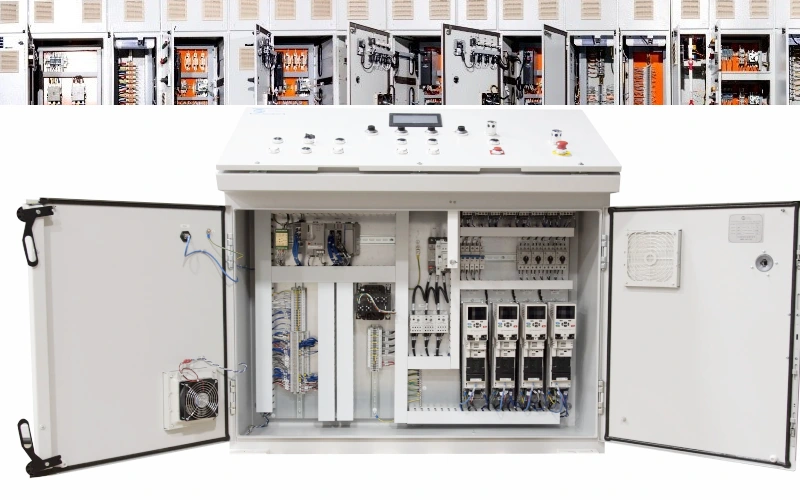 The control accuracy and response speed determine the system performance. The high-end ac controller panel should achieve a temperature control accuracy of ±0.5℃, 16-bit resolution for analog quantity acquisition, and a digital quantity response time of ≤10ms. Its PID regulation cycle can reach up to 100ms, and the communication interface supports industrial protocols such as PROFIBUS and Modbus. Application data from food processing enterprises show that high-precision control panels have reduced temperature fluctuations on production lines by 67% and increased the product qualification rate to 99.2%.
Safety compliance cannot be ignored. The ac controller panel must be certified by UL 508A and IEC 61439, and its electromagnetic compatibility must meet the EN 61000-6-2 standard. The emergency stop response time should be ≤20ms, and the safety circuit must comply with SIL level 2. According to OSHA statistics, control panels that meet safety standards have reduced industrial accident rates by 82% and equipment insurance costs by 35%.
The full life cycle cost analysis shows value differences. Although the initial cost of high-quality ac controller panel is 15-20% higher, the energy consumption is reduced by 23%, the maintenance cost is decreased by 61%, and the comprehensive return on investment is increased by 40%. Its modular design reduces component replacement time by 75%, and online firmware upgrades avoid production halt losses. The actual operation data of the chemical plant shows that the selection of high-end control panels has reduced the annual operating cost by 190,000 yuan per thousand square meters.
The degree of intelligence affects future expansion. Modern ac controller panels should integrate IoT interfaces, support cloud monitoring and data collection, and have a predictive maintenance accuracy rate of ≥85%. Its energy efficiency management system can optimize equipment operation in real time, achieving energy-saving effects of 15-25%. Cases of digital transformation in the manufacturing industry show that intelligent control panels have increased the equipment networking rate to 95% and raised production efficiency by 22%.
The control accuracy and response speed determine the system performance. The high-end ac controller panel should achieve a temperature control accuracy of ±0.5℃, 16-bit resolution for analog quantity acquisition, and a digital quantity response time of ≤10ms. Its PID regulation cycle can reach up to 100ms, and the communication interface supports industrial protocols such as PROFIBUS and Modbus. Application data from food processing enterprises show that high-precision control panels have reduced temperature fluctuations on production lines by 67% and increased the product qualification rate to 99.2%.
Safety compliance cannot be ignored. The ac controller panel must be certified by UL 508A and IEC 61439, and its electromagnetic compatibility must meet the EN 61000-6-2 standard. The emergency stop response time should be ≤20ms, and the safety circuit must comply with SIL level 2. According to OSHA statistics, control panels that meet safety standards have reduced industrial accident rates by 82% and equipment insurance costs by 35%.
The full life cycle cost analysis shows value differences. Although the initial cost of high-quality ac controller panel is 15-20% higher, the energy consumption is reduced by 23%, the maintenance cost is decreased by 61%, and the comprehensive return on investment is increased by 40%. Its modular design reduces component replacement time by 75%, and online firmware upgrades avoid production halt losses. The actual operation data of the chemical plant shows that the selection of high-end control panels has reduced the annual operating cost by 190,000 yuan per thousand square meters.
The degree of intelligence affects future expansion. Modern ac controller panels should integrate IoT interfaces, support cloud monitoring and data collection, and have a predictive maintenance accuracy rate of ≥85%. Its energy efficiency management system can optimize equipment operation in real time, achieving energy-saving effects of 15-25%. Cases of digital transformation in the manufacturing industry show that intelligent control panels have increased the equipment networking rate to 95% and raised production efficiency by 22%.
The control accuracy and response speed determine the system performance. The high-end ac controller panel should achieve a temperature control accuracy of ±0.5℃, 16-bit resolution for analog quantity acquisition, and a digital quantity response time of ≤10ms. Its PID regulation cycle can reach up to 100ms, and the communication interface supports industrial protocols such as PROFIBUS and Modbus. Application data from food processing enterprises show that high-precision control panels have reduced temperature fluctuations on production lines by 67% and increased the product qualification rate to 99.2%.
Safety compliance cannot be ignored. The ac controller panel must be certified by UL 508A and IEC 61439, and its electromagnetic compatibility must meet the EN 61000-6-2 standard. The emergency stop response time should be ≤20ms, and the safety circuit must comply with SIL level 2. According to OSHA statistics, control panels that meet safety standards have reduced industrial accident rates by 82% and equipment insurance costs by 35%.
The full life cycle cost analysis shows value differences. Although the initial cost of high-quality ac controller panel is 15-20% higher, the energy consumption is reduced by 23%, the maintenance cost is decreased by 61%, and the comprehensive return on investment is increased by 40%. Its modular design reduces component replacement time by 75%, and online firmware upgrades avoid production halt losses. The actual operation data of the chemical plant shows that the selection of high-end control panels has reduced the annual operating cost by 190,000 yuan per thousand square meters.
The degree of intelligence affects future expansion. Modern ac controller panels should integrate IoT interfaces, support cloud monitoring and data collection, and have a predictive maintenance accuracy rate of ≥85%. Its energy efficiency management system can optimize equipment operation in real time, achieving energy-saving effects of 15-25%. Cases of digital transformation in the manufacturing industry show that intelligent control panels have increased the equipment networking rate to 95% and raised production efficiency by 22%.
Ready to ship a site in 7 days?
Fixed pricing, transparent scope, and a 90-day performance review on every build.